
Saw #16: Reva Forth, Ported to Rust and WebAssembly, and CoSy on Top
2877 words • 15 min read • Abstract

This week’s saw is an old Forth and the language built on it. Reva is a compact Forth by Ron Aaron that compiles straight to 32-bit x86 machine code; its last release was 2011.2. CoSy, by Bob Armstrong, is an APL- and K-like vocabulary written on top of Reva. Both run only where 32-bit x86 runs, and CoSy’s distribution is built for Windows. I am carrying both forward: Reva to a portable Rust core that runs as a command-line tool on Linux, macOS and Windows (checked so far under Wine), in the browser and in a desktop app, and CoSy onto that core.
| Resource | Link |
|---|---|
| reva-fork | softwarewrighter/reva-fork (branch dev) |
| Live demos | Reva in the browser, CoSy in the browser (staging) |
| Demo script | docs/demo.md: what to type, step by step, from the terminal to the desktop app |
| Highlighter | forth-highlight.py, which made the code figures |
| Its design | rust/DESIGN.md |
| Reva, upstream | ronaaron/reva |
| CoSy | cosy.com, its Forth code; the older CoSyBob/CoSy repository |
| The CoSy port | private for now; a link when it is public |
| Video | CoSy fractals |
| Comments | Discord |
Why not just rewrite it
Reva compiles Forth to x86 machine code, and about 60 words in its Forth system, src/reva.f, and about 100 in its libraries are written as instruction bytes. Rewriting all of that for a new processor would make a new Forth, not a port. So reva-fork does something else: its portable core, written in Rust, executes the small subset of 32-bit x86 that Reva actually uses (called vx86) in a virtual machine over one flat 32-bit address space. That address space maps directly onto WebAssembly’s linear memory, and onto a single buffer on a 64-bit host. The routines Reva’s assembly core provided are re-implemented in Rust, at the addresses Reva expects, so the Forth side sees the same core it always did.
The result is that Reva’s own reva.f, release 2011.2, boots in full and unchanged: its embedded assembler, contexts, needs and libraries, does>, catch and throw, the FFI layer and the REPL. The design notes weigh the alternatives (a token-threaded VM, hand-written 64-bit assembly cores) against this one. The old wiki, which described the x86 distribution, is deprecated, and the new documentation is written from the portable core: every Forth sample in it is run as a test, beside unit tests and a golden-output regression suite (reg-rs).
Where reva-fork stands
The first commit of the portable core is from Saturday afternoon; this is where it stands on Sunday evening:
- The
revacommand runs on any 64-bit platform Rust supports. 69 of the 132 programs in Reva’sexamples/run unchanged, and a generated report tracks the rest. The REPL keeps a history and has Emacs-style line editing. - The browser: a WebAssembly module with no imports runs the VM in a Web Worker, in time slices, so the page never freezes and Stop interrupts a running word. Files live in browser storage. The site is a static zip that any web server can host, and
reva-servepacks the same site and a tiny web server into one local binary. - A desktop app: the same REPL in a Tauri window on Linux and macOS, with files in a folder on disk and packages, folders with their own start files. CoSy is one.
- Saved images (also in the browser),
restart, file words,time&date, and a version banner. - Windows: the command-line tool maps Windows paths (
C:\dir) onto the VM’s/-rooted ones, checked with a cross-builtreva.exeunder Wine, and the desktop app builds Windows installers, with a packaging guide. Neither has run on a Windows machine yet. - x87 floating point, the instructions Reva’s float library compiles to, now runs in the VM.
- Clear stops where the port ends: a native library the core does not serve prints a note naming it, and an unsupported instruction names its family (x87, MMX, SSE, privileged, I/O port) and points to the portability notes, instead of failing generically.
- Not yet: native C libraries, and translating hot code back to native instructions.
The next item on the roadmap is virtual libraries: Rust code inside the VM that serves the old library names, instead of loading native libraries: SQLite first, then a UI service and, later, 3D through WebGL, for the browser and the desktop app alike. The database and 3D graphics are for a planned post; this one stops at 2D.
Turtle graphics in reva-fork
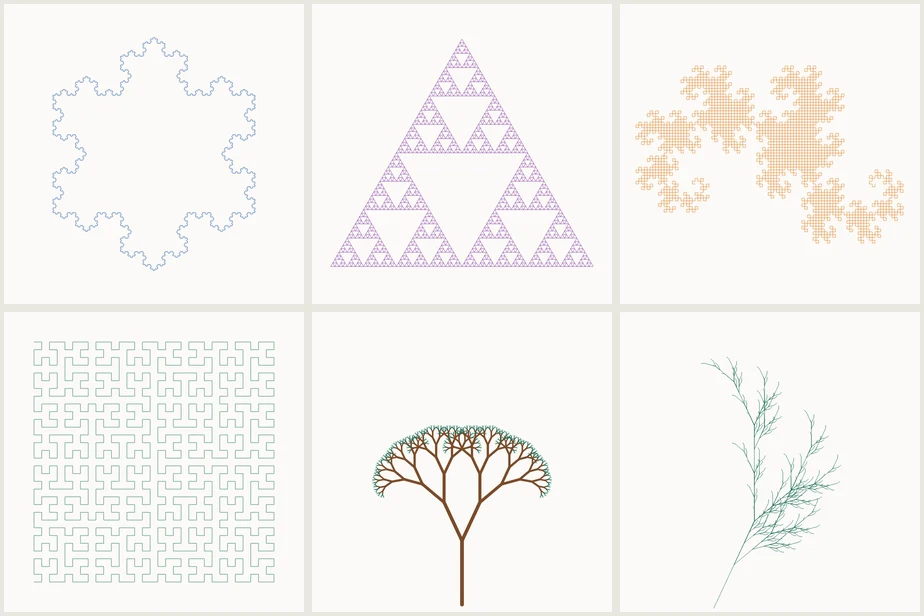
The first graphics in reva-fork are Logo’s: a turtle that moves, turns and draws (docs/turtle.md). It draws in a separate window in the desktop app, in a popup, pane or split view in the browser, and to an SVG file on the command line. The world is 800 by 800, angles are whole degrees, and every argument is an integer, so the turtle needs no floating point.
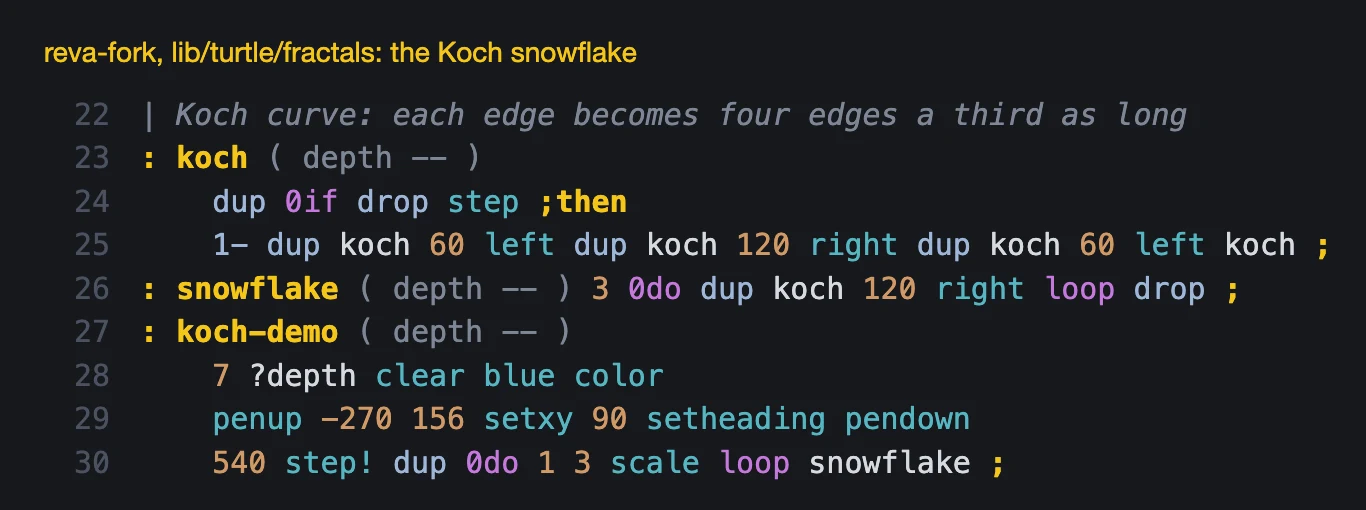
The fractal demos are written the Logo way, drawing while they recurse. A Koch curve at depth zero is one step; at any other depth it is four Koch curves a third the size, with turns between them:
: koch ( depth -- )
    dup 0if drop step ;then
    1- dup koch 60 left dup koch 120 right dup koch 60 left koch ;
: snowflake ( depth -- ) 3 0do dup koch 120 right loop drop ;
Each segment is one call to the turtle. The code figures in this post were made with forth-highlight.py, a small script now in both forks that turns Reva and CoSy source into color-highlighted HTML or PNG. The library has six such demos: the Koch snowflake, the Sierpinski triangle, the dragon curve, the Hilbert curve, a fractal tree, and a plant grown by a small L-system interpreter.
The highlighter did not stay a blog tool. Its rules moved into the VM as two REPL words, pp FILE and hl-type, which list Forth source in color in the terminal, the browser and the desktop app (pp turtle/fractals lists this library), while slurp type stays plain (docs/highlight.md). One token table, lib/highlight/forth.tbl, now drives both the REPL words and forth-highlight.py, so the figures here and the REPL color code the same way.
Try it in the Reva web demo:
needs turtle/fractals 5 koch-demo           | load and run
fractals                                    | list the demos
" /reva/lib/turtle/fractals" slurp type     | list the source
Other demos: 6 hilbert-demo, 6 sierpinski-demo, 12 dragon-demo, 10 tree-demo, 5 plant-demo.
Cleaning up as it goes
The original distribution carried prebuilt Windows and Linux binaries. reva-fork keeps the deprecated 32-bit x86 implementation under legacy/, and holds the rest to a stricter rule: no copyleft code, and no native libraries at run time, so it can be used commercially with no condition beyond credit, on every platform. Copyleft files the portable core never used (a GPL SHA-1 source, and MySQL, GnuPG, libiconv and pthreads libraries) were removed, and a license check now fails on any GPL, LGPL or AGPL text and on any binary not listed with its license. Reva itself is in the public domain, and its author asks for credit, which the fork gives.
CoSy on reva-fork
CoSy is the reason for all of this. It was built on an older Reva, 7.0.8, and it ships as a zip with its own Reva, Windows DLLs and a GUI built on IUP. The port has its own goals: no bundled binaries, nothing redistributed that is not licensed for commercial use, nothing Windows-only or x86-only, and, as with reva-fork, 2D and 3D graphics and a desktop app.
The first milestone landed on Sunday morning. A subset of CoSy loads to the end on reva-fork, 856 words with no errors, and vectors, reduce, strings, nested lists and its R dictionary work at the REPL. Getting there took:
- A small compatibility layer for the three things that changed between Reva 7.0.8 and 2011.2: words that went missing (
>defer,make,undo),valuebecoming a macro, and error names that now throw instead of being constants. - 23 source patches, each checked to match the expected number of times so the build fails if CoSy’s source changes under it.
- One VM fix in reva-fork: an x86 instruction form (
movwith a memory offset, opcodesa0toa3) that Reva’s locals library emits and CoSy relies on. - Leaving things out for now: the one piece of inline assembly that shelled out to an external assembler (now two bytes), the help system (it needs SQLite), and the GUI built on the IUP library, which also pulls in iconv through the FFI.
Since then, with x87 in the VM, CoSy runs with real floats, and it restores and saves its .csy workspaces again. It opens in reva-fork’s desktop app as a package with its own icon, runs in the browser from a static site (the demo linked above), and builds as one local binary, cosy-serve. Its About box credits Bob Armstrong and links CoSy.com.
For the desktop goal, make-cosy-app.sh builds a self-contained CoSy.app for macOS that can be given away: the app carries CoSy inside it, copies it on first launch to a folder the user can write to (keeping any files they added there), and runs it in reva-fork’s desktop app. CoSy also has its own token table, so pp colors CoSy’s verbs on top of Forth’s, and its own step-by-step demo script beside reva-fork’s.
The port also turned up two latent bugs in CoSy itself, broken on the original Reva too: two words spelled in the wrong case, and an undefined word that silently aborted the rest of one file.
The CoSy way: a curve is a list
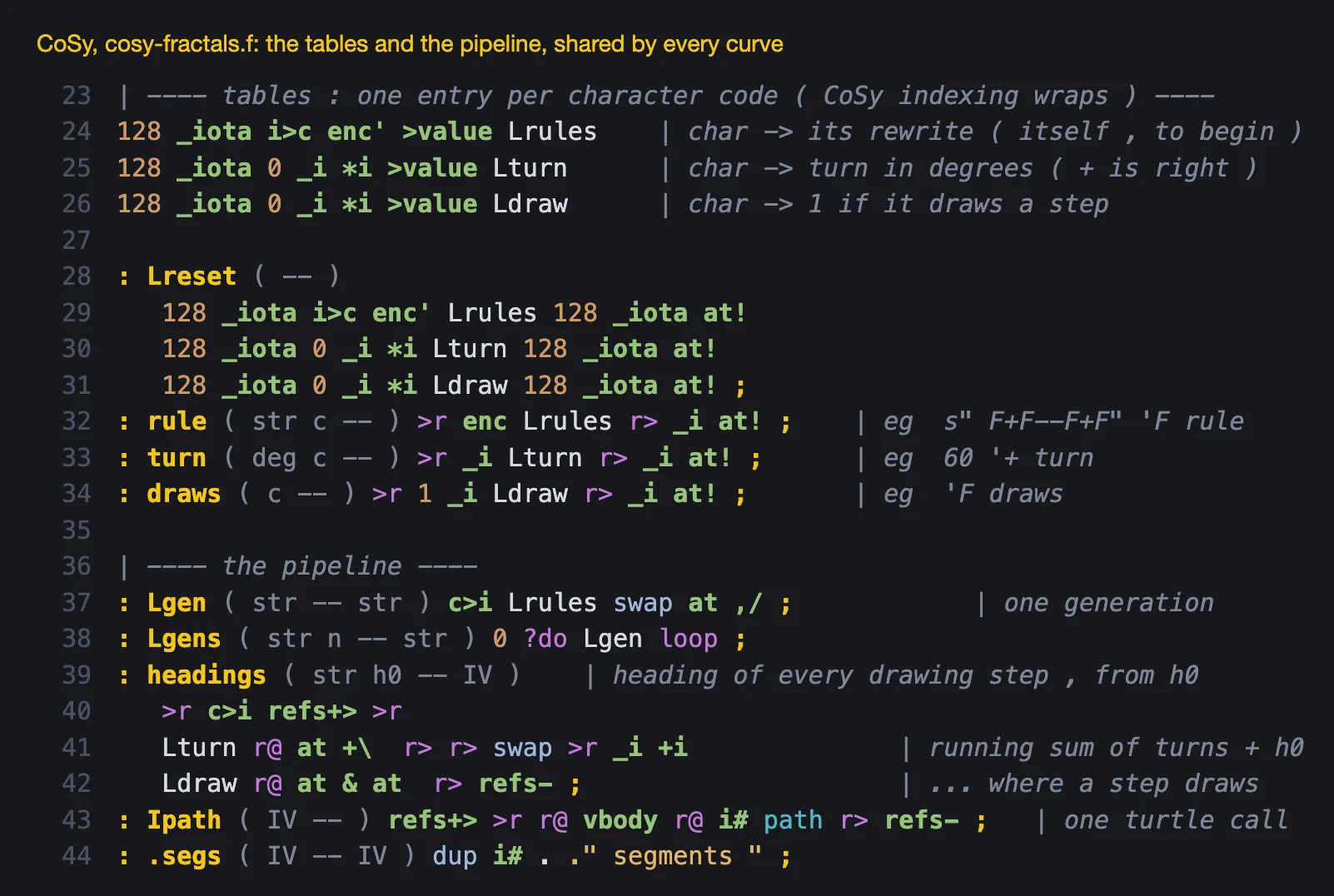
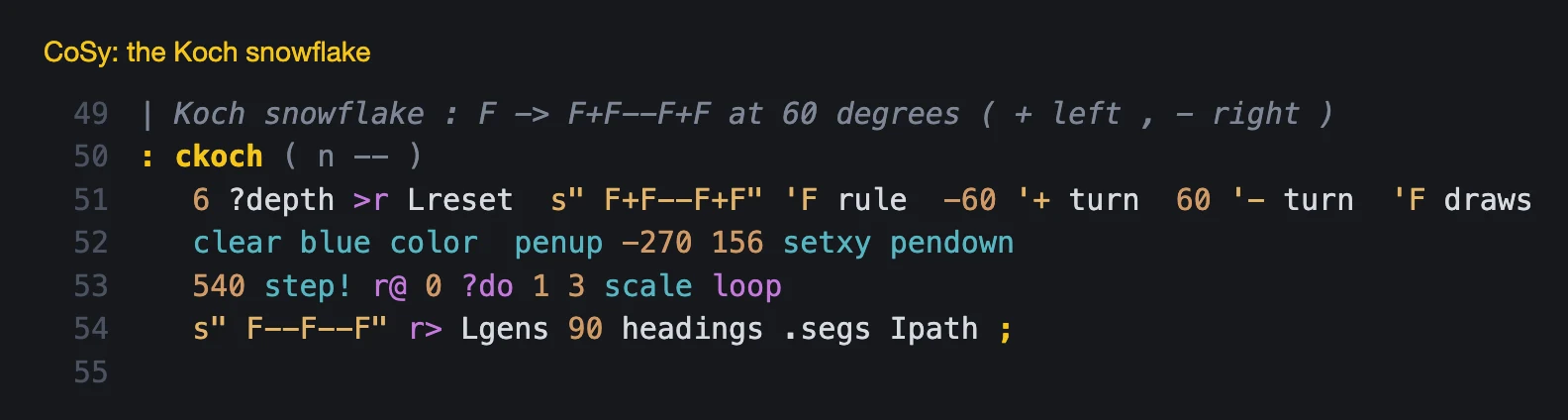
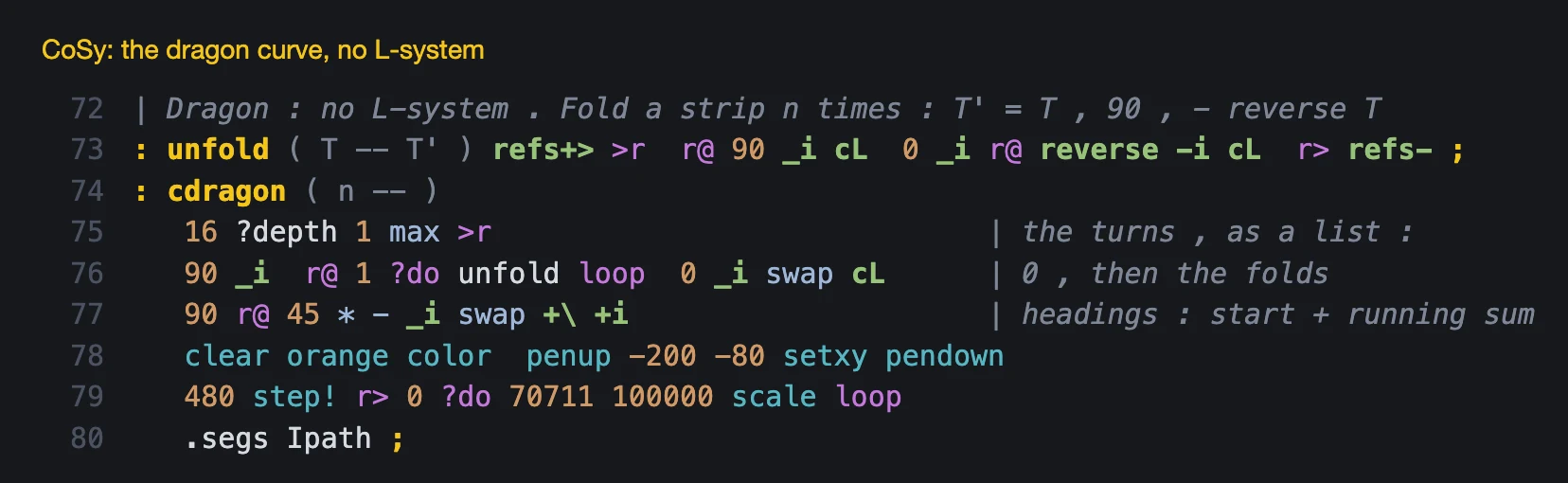
CoSy’s version of the same demos (cosy-fractals.f, in the CoSy fork, private for now) runs on the same turtle, but treats a curve as data first. An L-system generation is one index and one raze: each character is looked up in a table of rewrites, and the results are joined. The turns are another index into a table, the headings are a running sum of the turns (+\, APL’s scan), the drawing steps are selected with & (APL’s where), and the whole path goes to the turtle in one call. Between those steps the curve is an ordinary CoSy list, so it can be counted, reversed or combined before anything is drawn; each demo prints its segment count first (3,072 for the Koch snowflake at depth 5).
The dragon curve needs no L-system at all. Folding a strip of paper is a list operation: the turns after one more fold are the old turns, a 90, and the old turns reversed and negated, T , 90 , - reverse T.
| Curve | reva-fork, recursive | CoSy, as lists |
|---|---|---|
| Koch snowflake | 8 lines | 6 |
| Sierpinski | 12 (triangle) | 6 (arrowhead curve) |
| Hilbert | 11 | 6 |
| Dragon | 7 | 8 |
| Shared tables and pipeline | none | 18 |
Lines of code, comments left out. Each CoSy curve is a few lines on top of the shared pipeline; the dragon is about the same either way. The two files differ in what they cover, too: reva-fork’s also has the tree and the L-system plant, in 87 lines of code to CoSy’s 50.
Try it in the CoSy web demo:
include cosy-fractals.f 5 ckoch             | load and run
cfractals                                   | list the demos
" cosy-fractals.f" slurp type               | list the source
Other demos: 6 chilbert, 7 csierpinski, 12 cdragon. The Reva commands above work there too, since CoSy runs on Reva, so the two versions of each fractal can be drawn side by side. In the Reva demo the CoSy commands do not: cosy-fractals.f is not on that site, and listing it prints nothing.
Sharpening the saw
The usual small upkeep around the main work this week. I organized my Chrome tabs into groups, one each for AI tools, blogging, demos and presentations, among others. sed-rs, my portable sed subset in Rust, picked up the features the new reva-fork and CoSy build scripts needed: addresses, blocks, labels and branches. And I set up Claude in the cloud to work on several repositories at once, which is how both forks moved this fast over one weekend.
Next
For CoSy, the main gap is its GUI: the IUP widgets it used are what is still missing, and a terminal, browser and desktop front end on reva-fork has to replace them. Then a public link for the CoSy fork. For reva-fork, the virtual libraries, starting with the database, and 3D graphics; those, and what CoSy does with them, are for a planned post.
Part 16 of the Sharpen the Saw Sundays series. View all parts
Comments or questions? SW Lab Discord or YouTube @SoftwareWrighter.