
Saw #19: Taking Inventory --- agentrail, a Home Page, and a Week of X_eTaL
2298 words • 12 min read • Abstract

This Sunday’s saw changed twice while I wrote it. First I realized the agentrail change would lead to a lot of improvements, so it became the main story. Then I realized this is a good time to finally put content on my softwarewrighter.com home page. So the focus now is to look at my own work more carefully, take an inventory of it, and build a home page that indexes into it. The week’s other work follows.
| Resource | Link |
|---|---|
| agentrail | agentrail-rs |
| Video | X_eTaL-video, the videos |
| Snow | snowflow_demo-fork, live |
| City | X_eTaL-extensions, live |
| Models | console-3D |
| APL | sw-apl, live |
| ML | X_eTaL-ML, X_eTaL-fine-tuning, X_eTaL-manifolds |
| The series | Sharpen the Saw: every post |
| “Sharpen the Saw” | The 7 Habits of Highly Effective People (Stephen Covey) |
| Comments | Discord |
Taking inventory
I am building a tool that scans every clone on my main MacBook and my main Arch Linux workstation and indexes them into an inventory, not just by area of focus. It also lets me annotate each project’s goals and priority. Some projects were proofs of concept I may come back to. Some are on hold, or slowed while other projects mature. Some matter more than others, and some are tied to hardware. From that inventory I want to derive a home page that is actually useful: a way into the work, organized by what it is for and where it stands.


agentrail: session logs out of the repository
agentrail keeps an agent’s plan, steps and history in the repository it works on, under .agentrail/. It also used to keep a snapshot of the agent’s whole conversation there, a Claude Code JSONL log saved with every completed step, and that was a long-standing problem. A log quotes every file the agent read and only grows, so committing it with each step stored the whole log again every time, filled the repository with large files nobody needed, and published content that was never meant to be shared.
The fix moves session logs out of the repository, to ~/.agentrail/sessions/ in the user’s home directory, one folder per repository. agentrail complete still snapshots the log, just not into git. For repositories that already have logs committed, agentrail sessions migrate moves them out and stops tracking them. And a new size guard, agentrail check-size, which also runs on next, status and complete, warns at 10 MiB and fails at 95 MiB for any file under .agentrail/ that would be committed, before GitHub’s 100 MB limit refuses a push.
Each completed step now gets a readable transcript.md in place of the raw log. For keeping the logs anyway, agentrail shadow keeps them in a private store, usually a clone of a private git repository: shadow push writes each log compressed, with a checksum beside it, and shadow pull restores and verifies them on another machine. A migration guide walks a repository off its in-repo logs. The change is merged, and the new version is installed on my main machine.
At least twice now, an agent has reported that GitHub rejected a push because of a file’s size. So next I need to install it on my other development systems, and work out how to fix every repository that uses it: they all carry logs that can now be removed, at the cost of rewriting history and a force-push. This may be a good time to do something else instead: clone each one, prune the logs from its history, and create a new, smaller repository under a better organization name, then point the old, bloated repository, now deprecated, at its replacement.
X_eTaL video
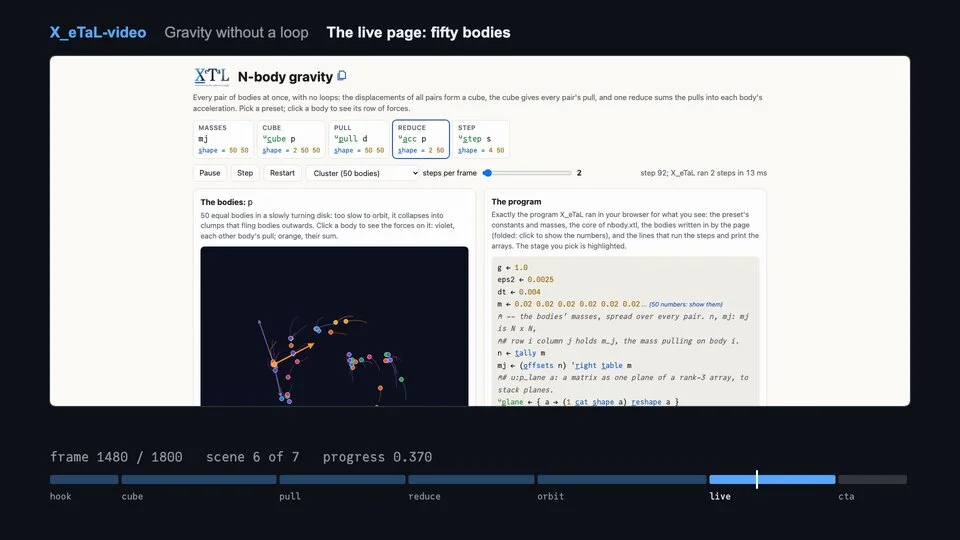
X_eTaL-video, new this week, makes educational videos about X_eTaL. A lesson is a JSON file; X_eTaL libraries compute its timing and animation as arrays, with Timeline, Ease and Spring (Remotion’s spring in closed form, checked against Remotion’s own numbers), and Remotion renders every frame, in landscape and in portrait. The X_eTaL code in a video is always shown drawn and syntax-colored, and long lines pan rather than shrink.
Five videos so far, all on the landing page: a making-of, the Game of Life twice (once drawn from the arrays X_eTaL printed, once captured from the live page), a 60-second Mandelbrot and a 60-second N-body, three bodies on a figure-eight. Narration is still to come.
When I made narrated videos before, I used VoxCPM, an open-weight text-to-speech model, on my Ryzen workstation, curiosity. Then I fried its motherboard adding a PCIe card, so that machine is in pieces, waiting for me to reassemble it with a new motherboard and an upgraded Ryzen CPU. Meanwhile I need to install VoxCPM on another workstation, with the RTX 5060 16 GB card I took out of curiosity. Once my text-to-speech pipeline is going again, I plan to make a new series of videos on what I have been working on for the last several months.
A snowy world
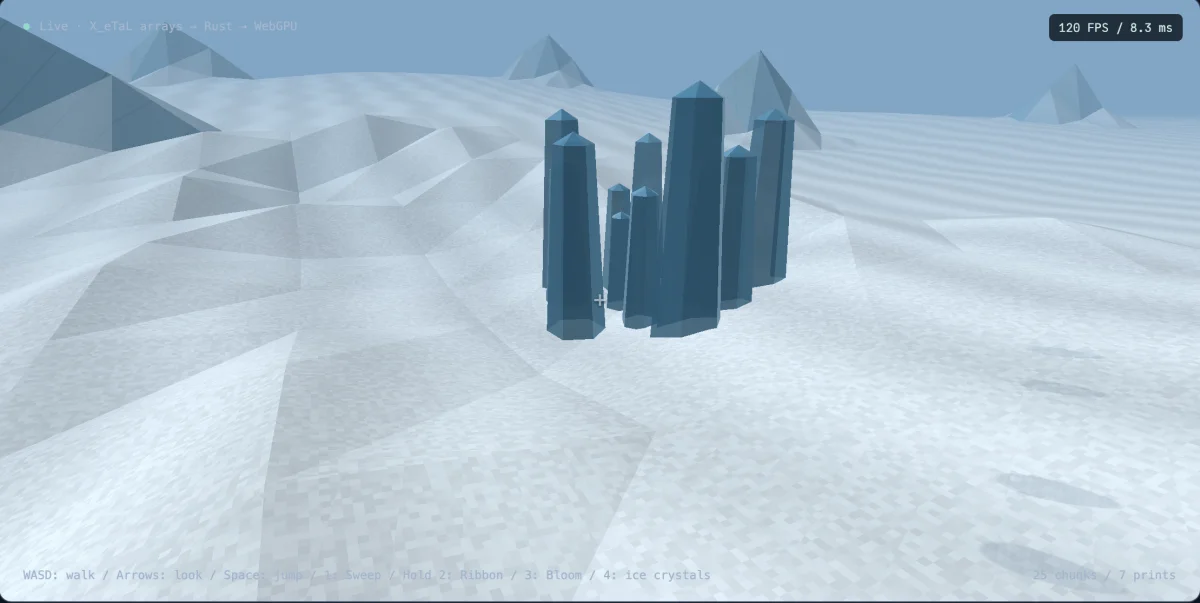
snowflow_demo-fork starts from Noniv’s snowflow demo, a real-time procedural snowfield in WebGPU, Babylon.js and hand-written WGSL. My fork, “X_eTaL snowy world”, rebuilds it so that pure X_eTaL array functions generate the terrain, chunk by chunk in a window that follows you, while Rust and WebAssembly handle the GPU, physics, procedural sound and footprints, with no hand-written application JavaScript. World state is immutable, updated by pure reducers.
It is live: an endless streamed snowfield to walk through, jump in and leave a trail across, with its X_eTaL source shown on the page. It needs a browser with WebGPU. Its graphics do not yet approach the original’s, so that is next to work on.
An IBM 029 keypunch
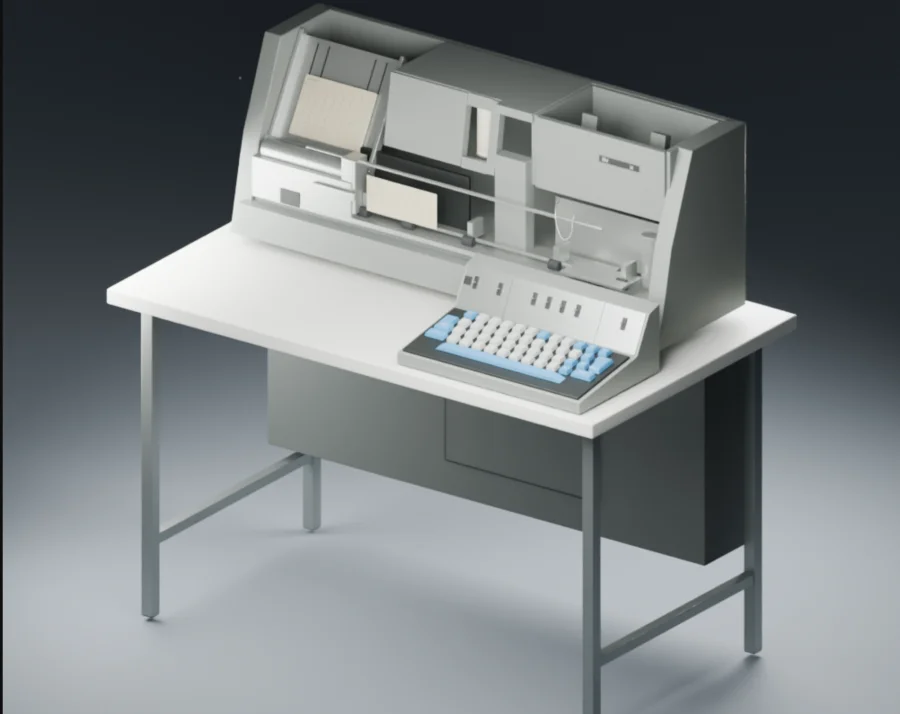
console-3D, my set of 3D models of old machines, has a new one: the IBM 029 card punch, the keypunch I typed programs on in college, with its card hopper, punch station, stacker and keyboard. It is part of a series of models for the 3D interactive virtual computer history museum I am building, sw-campus. It will first be used in the APL timeline, for the University of Maryland APL I used through punched cards on a UNIVAC in college.
APL, from C’80 to D’83
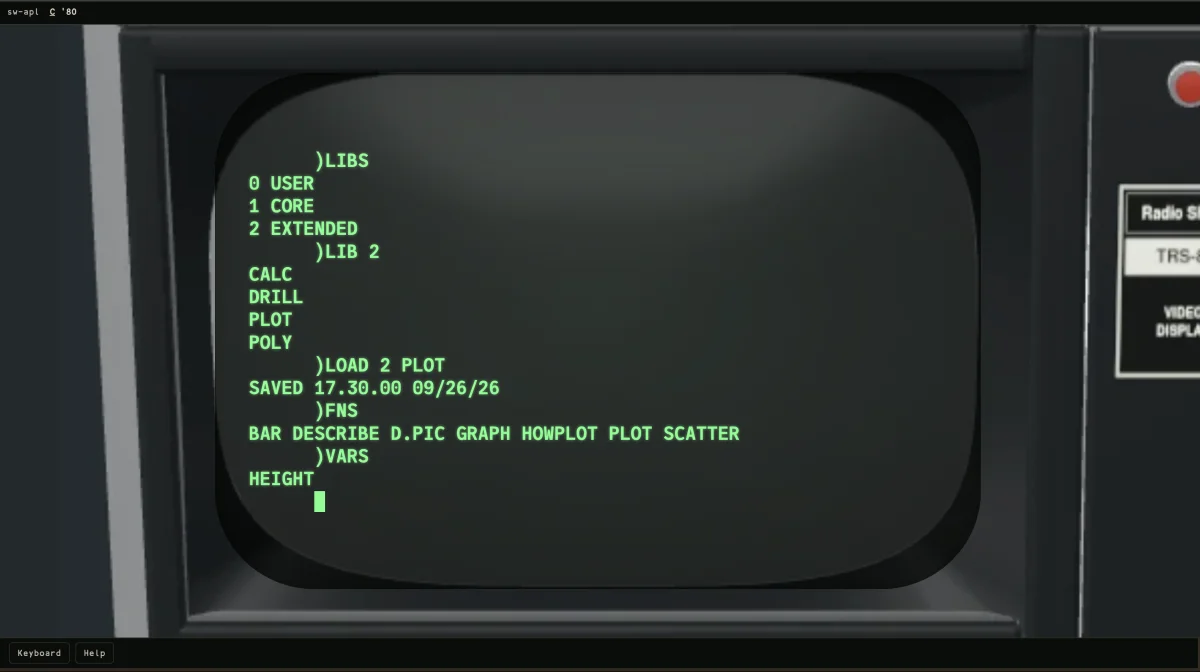
My APL site now opens on a landing page of machines and a timeline of APL. Its third live demo, C‘80, is APL80 on the TRS-80: APL80’s commands, its characters on the TRS-80’s screen, )RAM with peek, poke and Call, a small )DOS, pasted lines run one by one, the screen shown inside my TRS-80 monitor render, and workspaces ported to it, among them RACE, BIRDS, CALC, POLY, PLOT and DRILL.
Next is D‘83, IBM PC APL. It is under development, not live yet: text on the green monochrome monitor, with the custom character chip I ran on my own PC, and AP205 graphics on a CGA screen, such as a colored wireframe cube.
A neon city
In X_eTaL-extensions, NeonCity.xtl builds a rainy night city as arrays: 240 lots along an avenue, each tower’s height, footprint and skin drawn from a hash of its lot number and a seed, so the same seed gives the same city on every machine, plus rooftop machines, neon bands, screens, lamps, steam, two bridges, cars in four lanes and fliers. Blender can ray-trace it, about two minutes a 1080p frame on my M1 Max.
New this week, it is also interactive. A Three.js extension draws the same scene in real time in the browser, with wet-street reflections, neon and bloom: X_eTaL, compiled to WebAssembly, builds the city from a seed on the page, and another seed gives another city. Ride the camera’s flight, fly, or walk the streets.
A recent feature puts slide shows and animated GIFs on some of the billboards and screens. Some show abstract animations, some cycle through stills from my blog posts, and some play videos from my repositories.
Machine learning, fine-tuning and manifolds
In X_eTaL-ML, moe-finetune fine-tunes a small mixture-of-experts model to a changed task six ways, in the browser; only adding a new expert keeps the old task. VeRA joined the LoRA library and the LoRA explorer, and an ML timeline has begun, built on the Lisp timeline’s shell.
In X_eTaL-fine-tuning, lesson 5 puts LoRA beside LoRA-FA, and lesson 6 is the landscape, a map of six families of ways to change a model. A browser walk now checks every lesson for accessibility, keyboard, touch and replay.
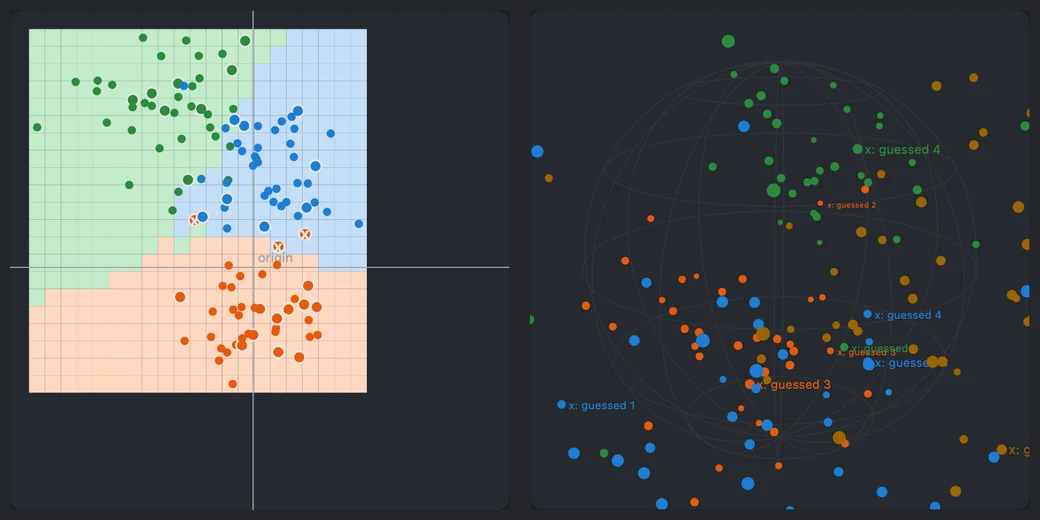
In X_eTaL-manifolds, its pages moved onto the shared teaching shell, and the representation explorer went live: the same points kept flat, measured by straight lines, and on the unit sphere, measured by angles, with everything else held equal, to test the first of its research questions. On these two small data sets the first test came out null: putting the points on the sphere did not change how well the model learned. The repository keeps that result, as its rules require.
Closing
Sharpening the saw this week was mostly about seeing the saw: which projects are tools, which are experiments, which wait on hardware, and which matter most. The inventory, and the home page it feeds, should make that visible, to me first and then to anyone who visits.
Next is finishing the inventory and the home page, moving my repositories off their old logs, and getting narration going again for the videos.
Part 19 of the Sharpen the Saw Sundays series. View all parts
Comments or questions? SW Lab Discord or YouTube @SoftwareWrighter.