TBT #15: APL\360 on an IBM 2741, Printing on Green-Bar Paper
1268 words • 7 min read • Abstract
The APL timeline I wrote about last week opens on 1970, and its first live demo is A‘70: APL\360 as people typed it then. Until now it printed in a browser font. As of this week it prints the way it did on an IBM 2741: a character at a time, on green-bar paper, with the sound of the keys, and in 3D on a model of the terminal itself. I used many Selectric terminals on the IBM System/360, 1130 and System/3 (and later on my TRS-80).
| Resource | Link |
|---|---|
| Video | APL\360 on a 3D IBM 2741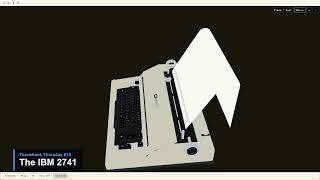 |
| Live demo | A‘70 on the 2741 |
| Timeline | APL timeline |
| Code | sw-apl, console-3D |
| Prior post | TBT #14: APL, Forth and Lisp Timelines |
| Comments | Discord |
The 2741
The IBM 2741 Communications Terminal was a Selectric typewriter turned into a terminal. With an APL type element in it, it was how most people met APL\360 in the late 1960s and early 1970s: you typed a line, the keyboard locked, and the answer came back on the same paper at about fifteen characters a second, the type element spinning and tilting to each character. APL’s special symbols were on that element, and the ones that weren’t were made by overstriking: one character, a backspace, and another on top of it.


Printing at the 2741’s pace
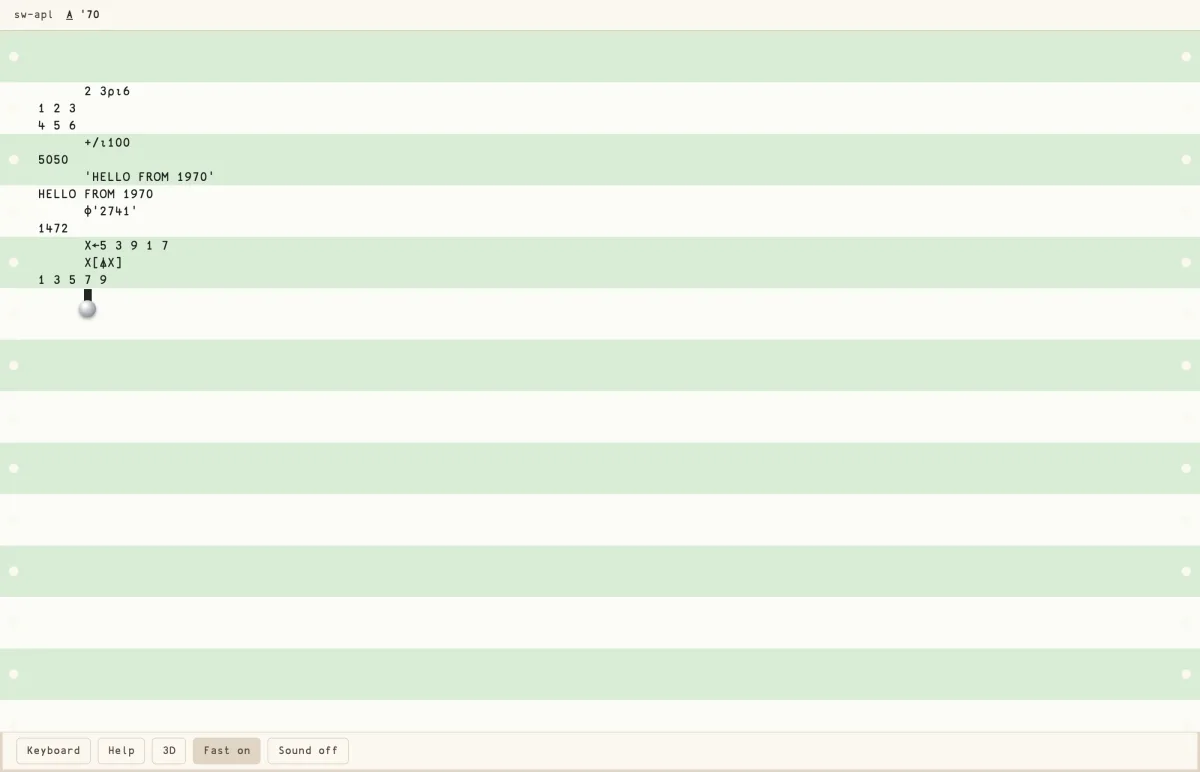
Now A‘70 sends what the session prints to the paper one character at a time, at about fifteen characters a second with a little jitter, and a carriage return takes longer the further the carriage has to travel. An overstrike is struck as its two parts with a backspace between them. The keyboard stays locked until printing finishes, as it did, and ATTN prints the rest at once.
The paper is continuous green-bar, stripes three lines deep, with a sprocket hole every half inch down both edges, all scrolling as it feeds. The line you’re typing goes on the paper at the six-space indent, and the type element waits there.
The sound is recorded, not synthesized: a key strike pitched a little by its character, the space bar, and a thud at the return. Two buttons in the bar control it: Fast prints everything at once, and Sound turns the sound on or off. Each visit opens on a card that starts the session with sound or silently, since a browser won’t play sound before a click.
The 2741 in 3D
)LIBS, )LIB 1, )LOAD 1 LIFE, DESCRIBE, ∇GEN[⎕]∇ to list Conway's Game of Life in two lines, RUN 2 for a glider's first two generations, then )CLEAR and blank lines to feed the paper. About a minute and a half; it loops. Click to enlarge.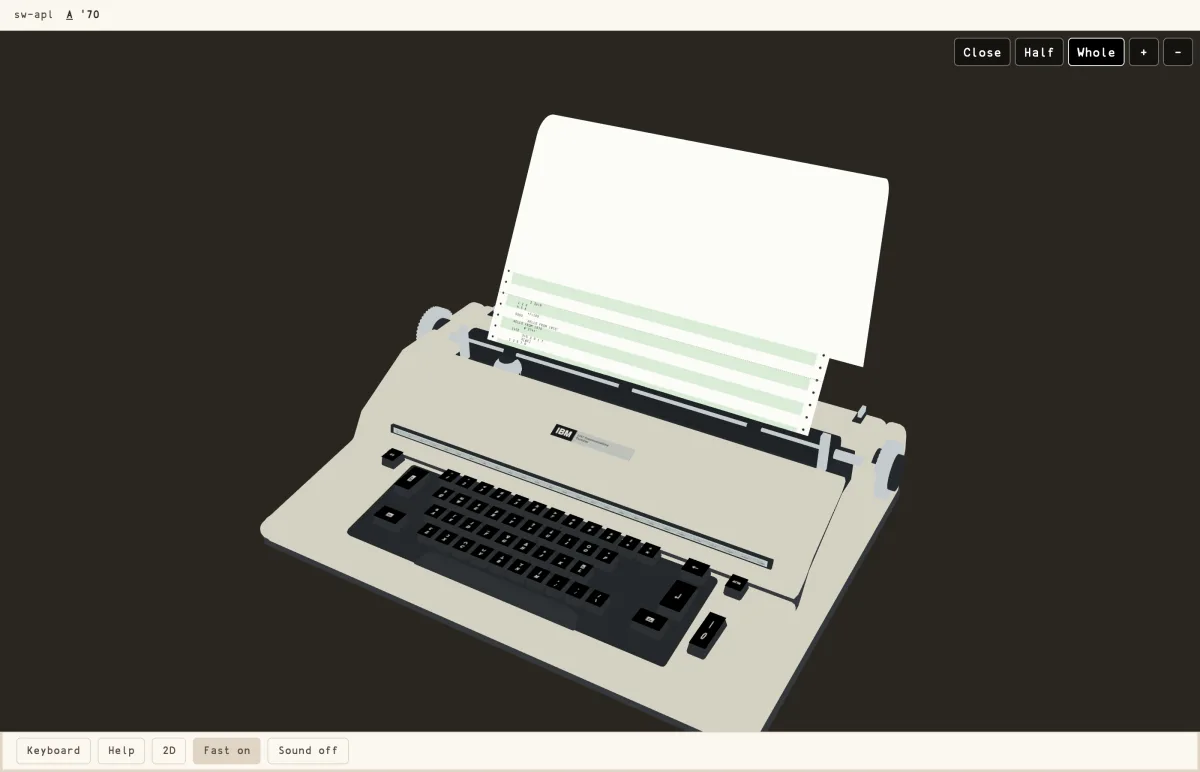
A‘70 now opens in 3D, on my model of the 2741 from console-3D, my set of 3D models of historical consoles and terminals. The model is built in Blender and drawn in the browser with three.js. As the session prints, the carrier moves to each column and back at the return, and the type element tilts and turns to each character.
The paper is one continuous strip of fan-fold green-bar, from the platen up past the top, over and down behind, with sprocket holes in both margins and a perforation every 66 lines. Printed lines move up at each line feed.
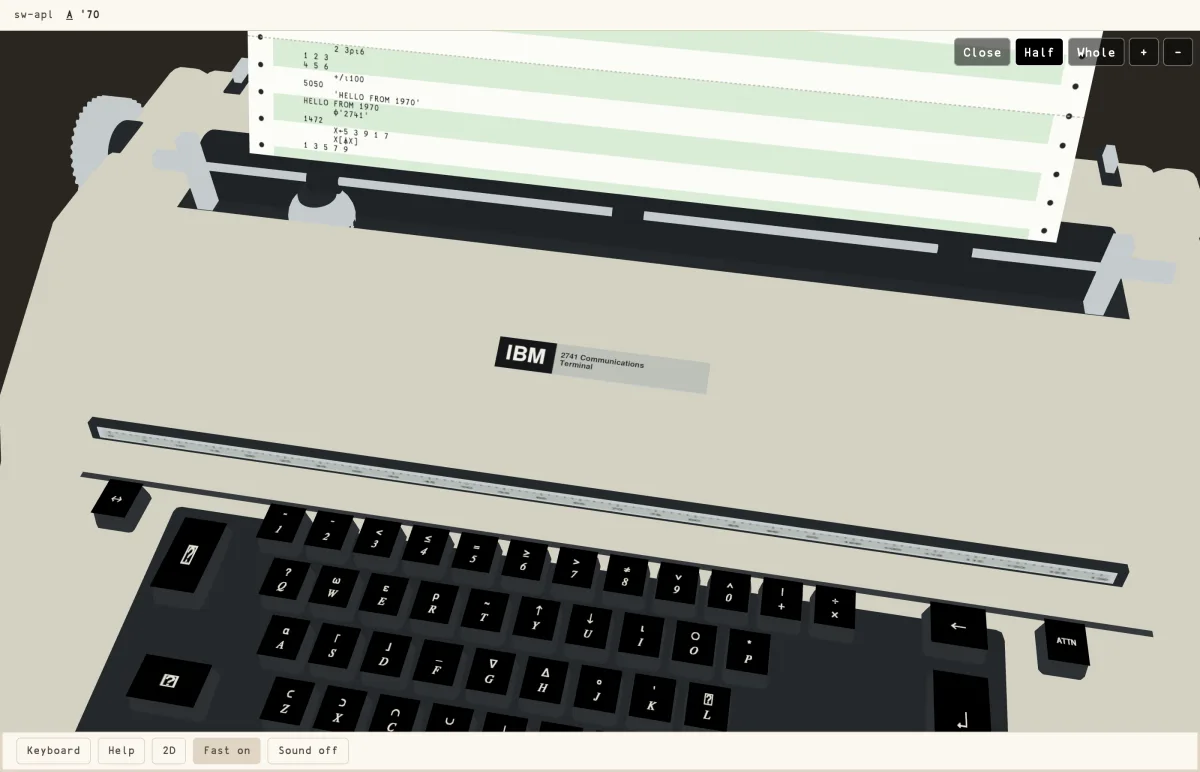
There are three views: Close, for reading while you type, the default; Half, with the keyboard; and Whole, the entire machine. A 2D button switches back to the flat paper, and your choice is remembered.
Try it
Open A‘70, choose Start with sound, and type a line, say 2 3⍴⍳6 or +/⍳100.
There are some anachronistic usability aids. The up arrow instantly brings back your prior input for editing, without animating its printing, until you press backspace to edit the recalled line. And if your keycaps don’t have APL decals, as mine do, the Keyboard button shows where each APL symbol is and helps you enter it. Help lists the rest.
Closing
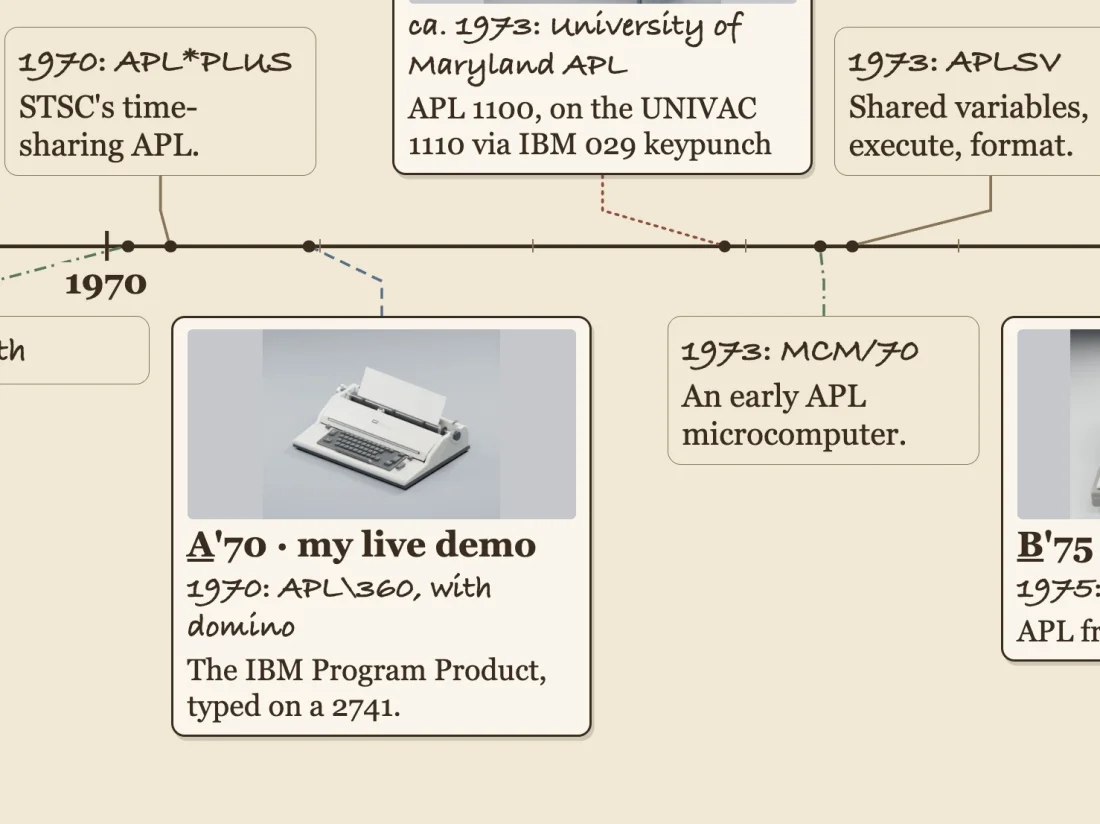
This is part of my ongoing work to build a virtual computer history museum, covering topics like APL, Forth, Lisp, and assemblers; the IBM 1130 and 1800, the UNIVAC 1110, the RCA CDP1802, the IBM 360, IBM 5100, IBM 3279G, and more.
The working APL-related demos currently linked from the timeline:
- APL\360, A‘70, on the 2741
- 5100 APL, B‘75
- APL80 on the TRS-80, C‘80
- IBM PC APL, D‘83
- COR24 APL
- sw-MLPL (new array language)
- X_eTaL (new array language)
Still to do: Keypunching University of Maryland APL/1100, IBM APL\1130 on an IBM 1053 Selectric console, and IBM APL2 on an IBM 3279G color CRT terminal.
Part 15 of the Throwback Thursday series. View all parts
Comments or questions? SW Lab Discord or YouTube @SoftwareWrighter.