
Array Languages #15: A Parsing Library for X_eTaL Macro Writers
2509 words • 13 min read • Abstract
| Resource | Link |
|---|---|
| The library | Parsing in X_eTaL-libraries · its reference |
| The guide | Writing a notation macro with Parsing — one macro built step by step, each tool in turn |
| The language | X_eTaL |
| Comments | Discord |
Every macro is a parser
An X_eTaL macro takes the text written at its call and returns code. A macro that only rearranges code, such as i̲f<, needs no parser. But a macro that embeds a notation does: the equation macro of post #11 reads a sum as a paper prints it, and the pipeline macro of post #12 reads stages joined by |>. Each one cuts its text at operators outside brackets, recognizes names, numbers and references like W[i,j], and has to say clearly when the text is wrong.
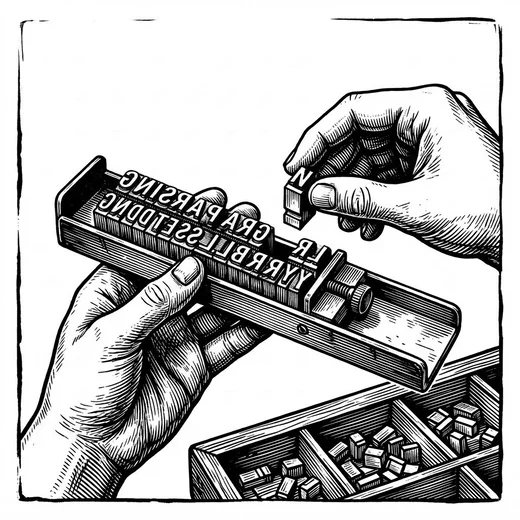
What is a composing stick? The tool in the picture at the top of this post. Before machines set type, a compositor built each line of a page by hand in a composing stick: a small metal tray held in one hand, its width set to the line’s measure. Letters, one piece of metal each, were picked from the type case one at a time and set in the stick, then spaced out until the line filled the measure exactly and could be lifted out as one piece. Every character was placed on purpose, and nothing was left loose. That is the idea this post borrows for parsing.
Until now each macro library wrote those pieces itself. That is where a silent wrong answer came from: the equation reader took a group in parentheses by dropping its first and last characters without checking that the last one closed it, so (y[i] - p[i])^2 lost its 2 and summed y - p, while its LaTeX printed what was written. The fix was a rule, every reading rule uses all of its text or refuses the call, and the rule is now a library.
The library
Parsing, in X_eTaL-libraries, imported with "pa:" u̲se< "Parsing", is an ordinary library of functions that a macro calls while it reads its text. It was generalized from the equation macro’s own helpers, and it has one rule: every piece either uses all of the text it is given, or stops the compile with an error that names the text. It has four kinds of tools.
Cutting text, bracket-aware. These never fail. ch ᵖᵃs̲plit t cuts at a separator, but only outside parentheses, brackets and braces, so a + inside (a+b) or c[i+1] is left alone:
"+" ᵖᵃs̲plit "(a+b) + c[i+1]"
┌→─────────────────┐
│ ┌→────┐ ┌→─────┐ │
│ │(a+b)│ │c[i+1]│ │
│ └─────┘ └──────┘ │
└∊─────────────────┘
ᵖᵃg̲roup? asks whether a text is exactly one parenthesized group, opening with ( and closing at its last character and nowhere sooner: "(a (b) c)" is one group, and "(a)(b)" is not, which is the very check the equation reader lacked.
Recognizing kinds of text. Questions answered 1 or 0: a name, a number ("0.5" is one, "2." is not), a word with its namespace, a function applied.
Parsers that take a piece apart or refuse. Each takes a tag, where, that says which error code to refuse with and where to point. The library’s tests wrap each one in a small macro, so its result and its refusals can be seen:
| Parser | Good input | Gives | Bad input | Refusal |
|---|---|---|---|---|
a chain, ᵖᵃp̲arts |
-a + b - c |
a, b, c; operators +-; opens with a minus |
a + - b |
an operator needs a value on each side |
a binding, ᵖᵃb̲inding |
sum i:=0..n |
sum, i, 0, n |
sum i=0..n |
a binding is a word, an index, := and a range low..high |
a function applied, ᵖᵃa̲pplied |
exp(z[i], 2) |
exp; z[i], 2 |
exp(z[i]) + 1 |
a function applied is a name, then its arguments in parentheses that end the text |
a reference, ᵖᵃr̲eference |
W[i,j] |
W; i, j |
W[i,j]2 |
an array reference ends with its closing bracket; nothing follows it |
Every refusal names the text it could not use, so the user sees what was wrong, not only that something was.
Guards. ᵖᵃc̲haracters refuses any character outside the notation’s alphabet and names it (not a character of this notation: 2); ᵖᵃr̲equire refuses unless a condition holds; and ᵖᵃw̲hole is the safety net, below.
This is how a macro uses it, the reference parser’s test macro in full:
⍝│ uses: parsed
ᵐr̲eference< ← { @ t →
  (name, ix) ← "bad-text right" ᵖᵃr̲eference t
  "\"" c̲at name c̲at ": " c̲at ("|" ᵗj̲oin ix) c̲at "\""
}
The tag "bad-text right" says: refuse with error[bad-text], pointing at the call’s right side. A real notation passes its own code, "bad-equation right" in the equation library, so its users see the notation’s own errors.
To see all of it used together, the library’s guide builds one small notation macro from nothing, for<, which reads stepped ranges written the way a paper writes them, for i:=0..10 by 2. It reaches for each kind of tool in the order a real macro needs them, cutting the list, reading each binding, checking the optional step, and finally writing the whole parse back to prove nothing was dropped, and it explains the where tag in a section of its own. The finished macro is now a small library of its own, Ranges, whose one macro is rg:f_or<.
What it refuses
A refusal carries the calling macro’s own error code, so a notation built on the library keeps its voice. Through the equation macro, a reference must end at its bracket:
"L[] | " ᵉe̲q< "sum i:=0..n - 1 | y[i]2"
error[bad-equation]: an array reference ends with its closing bracket; nothing follows it: y[i]2
And the whole-text check catches a parser that dropped anything at all, whatever the rule that dropped it. The library’s own test gives it a parse with the last character missing, through a small probe macro whose code is bad-text:
error[bad-text]: the parser did not use all of the text: it read a from ab
That check is the guard for the whole class of bug. A rule can be wrong in ways nobody thought to test, but if the parse written back is not the text that was written, the call is refused at compile time instead of running.
The language’s part
A library only protects the macros that use it, so the language now checks every macro too. A macro declares a contract in the documentation above its definition: how it is called, and whether it copies its text into its expansion or parses it. For a macro that copies, the default, the macro runner checks that every name and number of the call’s text reaches the expansion. A toy macro that forgets the power of what it was given:
@ q:s̲quare< "3 ^ 2"
error[unused-argument]: q:s_quare< did not use 2 of the text on its right; a macro that copies its text writes every name and number of it (## uses: copied)
A macro that parses a notation cannot be checked that way, since its expansion is not a copy of its text, so it says ## uses: parsed, and the parsing library’s whole-text check is its guard. Every macro in the libraries now declares which kind it is.
Before and after
The equation macro has moved onto the library. Its own group, chain, binding, function, reference and splitting helpers are gone, replaced by calls to pa:, and nothing it does changed: every test, the differential test that generates random equations, and the demos came out the same. Moving it found one more case its old reader had let through: a result with text after its brackets, Y[o]2, was read as Y[o]. It is now refused. The Tags library’s macros moved too, and now write each declaration back and compare it with the text.
The integrals added to the equation macro since (post #13) read their bounds and bodies through it as well. The pipeline macro, Flow in X_eTaL-ML, has a reader of its own, written to the same rule from the start: it declares ## uses: parsed, its tests refuse sixteen kinds of wrong text, and a round-trip test checks that what it writes back is what was written.
Since then the library’s own authors have used it on the rest of their macro libraries, as dogfooding rather than repair. Four more now read their text through Parsing: Bits, Check, Csv and Graphs, each taking the library’s name check or its position search in place of its own copy, and each library’s tests came out unchanged. Two of them, Check and Graphs, had been splitting with the Strings library’s split, which does not know about brackets; their inputs never hold one, so it fixed nothing today, but now every list-splitting macro uses the same tool.
Two were looked at and left alone, and the reasons are the useful part. Dates checks its characters with an error of its own, ... is not a date: write it yyyy-mm-dd, and Parsing’s character check would have replaced it with a generic one; better wording beats sharing a function. Polynomials reads numbers such as 2. and .5, which Parsing’s number check refuses, so moving it would have changed what the notation accepts. A shared tool is worth using where it fits, and not worth forcing where it does not.
The library also carries the bug that started all of this as a demo, the check any reader might write first beside the library’s:
term ← "(y - p)^2"
ᵘn̲aiveGroup? ← { t → ("(" m̲atch 1 t̲ake t) ∧ 0 < '+ r̲/ 0 + t m̲ember? ")" }
ᵘn̲aiveGroup? term
ᵖᵃg̲roup? term
y ← 5.0
p ← 3.0
y − p
(y − p) ^ 2
1
0
2.0
4.0
The naive check sees an opening parenthesis and a closing one somewhere and says the text is a group; ᵖᵃg̲roup? says it is not, because the closing parenthesis is not the last character. Read the first way, the term is y - p, 2.0; it is (y - p)^2, 4.0. The demo also runs in the libraries’ cross-reference site, with the Ranges library and its demo.
[Ed. 2026/10/21: Added the Parsing library's before-and-after demo of the bug that started this post, with its output, and a link to the libraries' cross-reference site, both published after this post (X_eTaL-libraries d9d157e, 5e6ba9c); this post's history.]
Part 15 of the Array Languages series. View all parts | Next: Part 16 →
Comments or questions? SW Lab Discord or YouTube @SoftwareWrighter.