Worth Reading #3: Design Patterns and Testing --- the Gang of Four, Pree and Binder
1253 words • 7 min read • Abstract
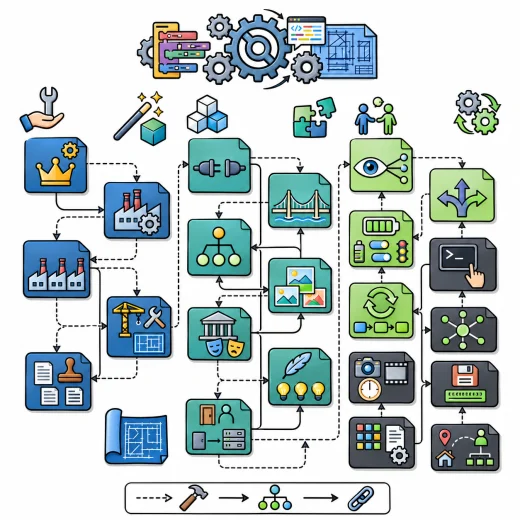
The prior post in this series was about architecture and design. This one is about what software made of Alexander’s idea.
I knew some of these authors a little. I worked at IBM’s T.J. Watson Research Center in Hawthorne, New York, in the same building as John Vlissides, though I talked with him only once, after Design Patterns was published. I also got to read an internally circulated draft of Design Patterns before it was published. I met Ralph Johnson at the University of Illinois at Urbana-Champaign, when IBM flew me out with a proposal for a joint project, one IBM later decided not to pursue. And I regularly attended the ACM OOPSLA conferences in the 1990s, where the other authors presented.
| Book | Author(s), year |
|---|---|
| Design Patterns | Gamma, Helm, Johnson, Vlissides, 1994 |
| Design Patterns for Object-Oriented Software Development | Wolfgang Pree, 1995 |
| Testing Object-Oriented Systems | Robert V. Binder, 1999 |
| The series | Worth Reading: every post |
| Comments | Discord |
Design Patterns
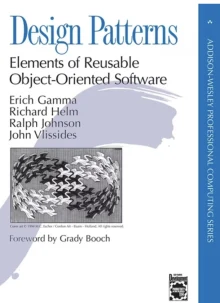
Erich Gamma, Richard Helm, Ralph Johnson and John Vlissides, the Gang of Four, Design Patterns: Elements of Reusable Object-Oriented Software (1994). Twenty-three object-oriented patterns, named and catalogued after Alexander’s example.
I embraced it when I was implementing Java libraries for mainframe record-oriented file systems, using Builder, Facade, Chain of Responsibility and others. This book was very influential on my work, and it improved my skills.
Because I had built a testable, pluggable, composable object-oriented implementation that could emulate the mainframe code on other systems, I could write Java on a PC, test it on an RS/6000 AIX workstation, and deploy it on a mainframe. A fun project I implemented was a distributed file explorer that ran on a Windows, Linux or AIX desktop and showed the file systems across those machines and a mainframe. You could copy files from one system to another, converting between ASCII and EBCDIC as needed. You could also drag a file onto a picture of a wormhole in space on one desktop and have it appear at a matching wormhole on another desktop; a colleague prototyped that, and I applied it to my file explorer.


Design Patterns for Object-Oriented Software Development
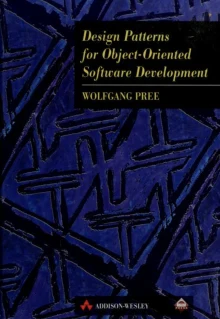
Wolfgang Pree, Design Patterns for Object-Oriented Software Development (Addison-Wesley and ACM Press, 1995). Patterns one level up: metapatterns, a small set that describes the patterns of application frameworks, and hot spots, the places where a framework is meant to vary and be extended, worked through on the C++ GUI framework ET++.
Around the same time I read many patterns books that tried to catalog many more application patterns. Those turned out not to be very relevant to my systems programming, what would later be called platform engineering. Of all of them, Pree’s book stood out, and it really resonated with me.
Pree divides any reusable framework into two fundamental parts: frozen spots, which stay the same in every application built on it, and hot spots, where each application varies it. He shows that many of the Gang of Four’s 23 patterns are variations on template and hook methods: a template method that holds the frozen part and calls hook methods for the hot spots. I found that very insightful, and directly applicable to my object-oriented analysis and design work.
Testing Object-Oriented Systems
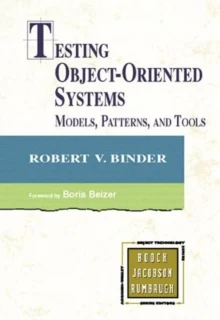
Robert V. Binder, Testing Object-Oriented Systems: Models, Patterns, and Tools (Addison-Wesley, 1999). Testing for object-oriented designs: test models drawn from the design, and test design patterns, catalogued the way design patterns were.
Through my software development career, the number of developers and the number of testers (QA and QE) were often out of balance. We used testers to help implement features when we were short of developers, and developers to write and run tests when we were short of testers. That got me interested in testing techniques and tools. This was the most comprehensive book I could find, and while it covers testing object-oriented code, a lot of it applies to other ways of building software.
It influenced me to create many testing frameworks later: JUnit-like ones for languages such as Forte 4GL, Guidewire Gosu and my own sw-MLPL (mlplunit). I ported regress, a C++ golden-file CLI testing tool, to Java, and later to Rust, then adapted it for AI coding and testing as reg-rs. I have also written fuzzers, mocks, spies, dummies, fixtures and more. I am still very interested in testing, and I use various tools every day to make sure my AI coding work is of higher quality and doesn’t break when new features or fixes are added.
Closing
These books were among my favorites during one of the most fun parts of my career. I have since moved on from object-oriented languages and applications, but a lot of their ideas are still relevant to functional programming, and even to array programming languages.
Part 3 of the Worth Reading series. View all parts
Comments or questions? SW Lab Discord or YouTube @SoftwareWrighter.